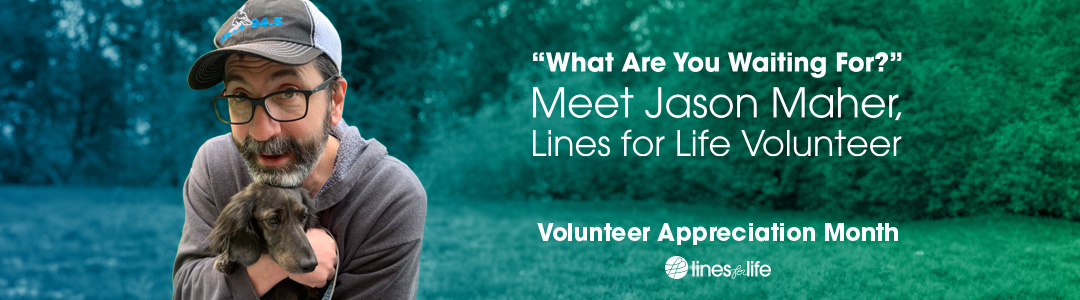
Jason grew up in central Illinois and the Chicago suburbs with a dream of becoming an actor, which he pursued in New York City for several years. There, he met his wife, and the two now have a daughter in college. For the last two and a half decades, he has worked in higher education in Minneapolis, rural Iowa and now Portland, where he serves as the Registrar at Reed College.
When Jason moved to Portland in 2021, the pandemic was still reshaping daily life in ways that were hard to ignore. He wanted to help — specifically, to support people struggling with the mental health and substance use fallout of those years. A Google search turned up Lines for Life.
That was January 2023. Since then, he has answered 357 calls.
What made you want to volunteer with Lines for Life?
I’ve often been told I’m good in a crisis and have a natural talent for de-escalation, so I wanted to volunteer somewhere that would let me put those skills to use and develop them further.
What did you hope volunteering would give you? Has it?
For whatever reason, I think I’m a naturally judgy person, and I wanted a volunteer opportunity that would challenge those inclinations and any of my implicit biases. I’ve found it’s impossible to effectively support someone in crisis and simultaneously judge their state, choices, and perspectives. Volunteering at Lines for Life has definitely helped me set aside my judgments and meet people where they are.
What does a typical shift look like for you?
Something I love about volunteering here is, there really isn’t a “typical shift.” On one call I’m talking about old movies with a frequent caller, the next I’m safety planning with a high-acuity caller, the next I’m searching databases for substance use programs, and the next I’m listening to a caller sing a song or recite a poem they wrote. The common thread is actively listening and supporting callers’ needs in the moment.
What’s the hardest part of the work?
Remembering that the caller is the expert in their own life and refraining from giving advice. Also, I like to talk, so keeping lower-acuity calls to a time limit can be hard. But it’s necessary to make sure we’re getting to the higher-acuity callers.
What does it feel like when a call goes well?
There’s the obvious feeling of accomplishment — knowing you did a good job and helped someone. But I try not to dwell there too long, because there’s always the next call. Feeling like you’ve “got this down” can be a treacherous state for a volunteer because it can put you on autopilot rather than keeping you present and listening.
What have you learned that you didn’t expect?
That most people think they’re alone — and they aren’t. There is a lot of shame and stigma around mental health, substance use, and suicidal ideation, and that isolation is real. Validating a caller’s feelings or normalizing their thoughts can ground them and connect them back to life and humanity. Even simple statements like “Anyone in your situation would feel the same” can make a profound difference. With that understanding, I also try to self-validate and normalize my own thoughts and feelings.
What do you wish more people understood about the people who call?
Our callers are everyone. I’ve spoken to overwhelmed parents and straight-A high school students, retired high-ranking military and business professionals, and just ordinary folks struggling through a tough patch. Literally anyone can encounter serious life challenges and find themselves in crisis.
What would you say to someone thinking about volunteering, but hasn’t taken the step yet?
What are you waiting for?
Why does this work matter beyond the individual calls?
I find it deeply meaningful and life-affirming that anyone with access to a phone, at any time, from anywhere, can reach out and talk to a compassionate and trained human being. While we often fall short as individuals, as a culture or as a country, the fact such a network of people even exists is so hopeful and beautiful.
What keeps you coming back?
The next caller. And the community of Lines for Life volunteers, supervisors, and trainers.
Interested in volunteering with Lines for Life?
Visit linesforlife.org/about-us/volunteer to learn more and apply.