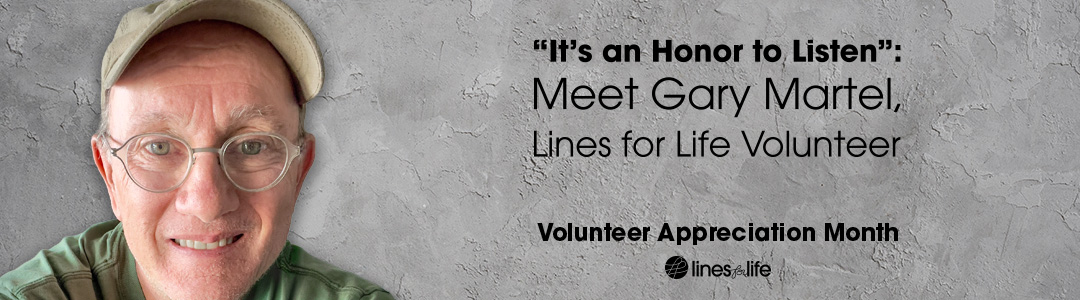
Gary has been a Portland resident since 1990. He and his wife have two children and three grandchildren.
Gary spent more than three decades as a dentist before retiring about 10 years ago. In retirement, he didn’t slow down, he leaned in. He has volunteered with a number of organizations over the years, always looking for meaningful ways to give back. When it was time to find something new, he went looking online, where he discovered Lines for Life.
Since then, Gary has answered 305 calls.
What made you want to volunteer with Lines for Life?
Volunteering has become one of the most important things I do every week. I consider it an honor to simply listen. Giving people an opportunity to speak to someone who is nonjudgmental and genuinely present — I’ve found that letting people express themselves and vent can be very healing.
What did you hope volunteering would give you? Has it?
I was hoping it would give me another avenue to give back to the community and to help address some of the major issues going on in society. And yes, I’ve found that.
What does a typical shift look like for you?
I’ve always taken the early morning Monday shifts. I get to the office, log on, and get a cup of tea. Then I prepare — get my notes ready, focus my mind on what calls might be like, and how I want to show up. And then that first call comes in, and I just go to work. My calls tend to run a little longer than average, so I typically take about five or six per shift.
What’s the hardest part of the work?
What’s hard has changed over time. When I was new, some of the very dire situations callers were dealing with would really tear me up emotionally. The calls would stay with me for days and affect my mood. Over time, I’ve learned to recognize the difficulty of what people are carrying without internalizing it so much. I think I’m more effective that way and it’s definitely healthier. Debriefing has helped a lot with that too.
What does it feel like when a call goes well?
I notice it in the caller’s voice. Sometimes a call comes in, and the person is speaking very rapidly — sometimes even crying. As the call continues and they have a chance to express themselves, I notice the speech slowing down. They start thinking a little more clearly. And I’m really gratified when, at the end of the call, the caller thanks me and says this has been helpful. They agree to a plan. They say I’m going to do this. I feel like I have something to work toward. And the call ends, and I feel a real sense of accomplishment and satisfaction.
What have you learned that you didn’t expect?
This work has reinforced something I suspected but now understand more deeply. People start from very different places. Some people have privilege and resources right from the beginning, and that opens doors. Others start from trauma — family trauma, financial disadvantage, lack of resources — and those early experiences stay with people. They often carry them their entire lives and have to work much harder just to navigate a path forward.
About myself: I’ve had to confront the fact I’m a fixer. My instinct when someone presents a problem is to immediately think about how to solve it. But not everyone wants a fix. A lot of people just want to be listened to and acknowledged. Learning to sit with that — to be fully present without rushing toward a solution — has been one of the most meaningful things this work has taught me.
What do you wish more people understood about the people who call?
There’s no one solution to what our callers are dealing with. You hear a lot of reactions to the problems facing communities — homelessness, substance use, lack of housing — and people want a simple fix. But I’ve learned that the issues our callers face are rooted in a long-running breakdown of systems and support. Addressing them requires empathy, a willingness to acknowledge inequity and a commitment to real, sustained change — not a single answer. What Lines for Life does is offer one essential piece of a much larger puzzle. And that piece matters.
What would you say to someone thinking about volunteering, but hasn’t taken the step yet?
Come down and visit. Meet the supervisors, see the facility, and get a sense of the support that’s here for volunteers. The training program is comprehensive, educational, and rewarding. The idea of talking to someone who is considering suicide is a heavy thing. But the training really does prepare you, and the staff is genuinely supportive. If this kind of volunteering resonates with you, I would absolutely encourage you to look into it.
Why does this work matter beyond the individual calls?
There aren’t a lot of resources like ours. Lines for Life is providing a needed service — one aspect of the many things that are required for communities to heal. I genuinely believe that if we could expand even further, more people would benefit. What we do matters.
What keeps you coming back?
Mainly because I feel I’m making a difference. And it feels good to make a difference. It’s very meaningful for me to be in that position and have that opportunity.
Interested in volunteering with Lines for Life?
Visit linesforlife.org/about-us/volunteer to learn more and apply.